Your Five Senses in Labor - Taste (Part One: Food)
Average Read Time: 4-6 minutes
What’s your favorite food? Mine fluctuates based on my mood - oreos if I need a sweet treat, labneh and pita if I crave a dip, stews and soups if it’s cold out.
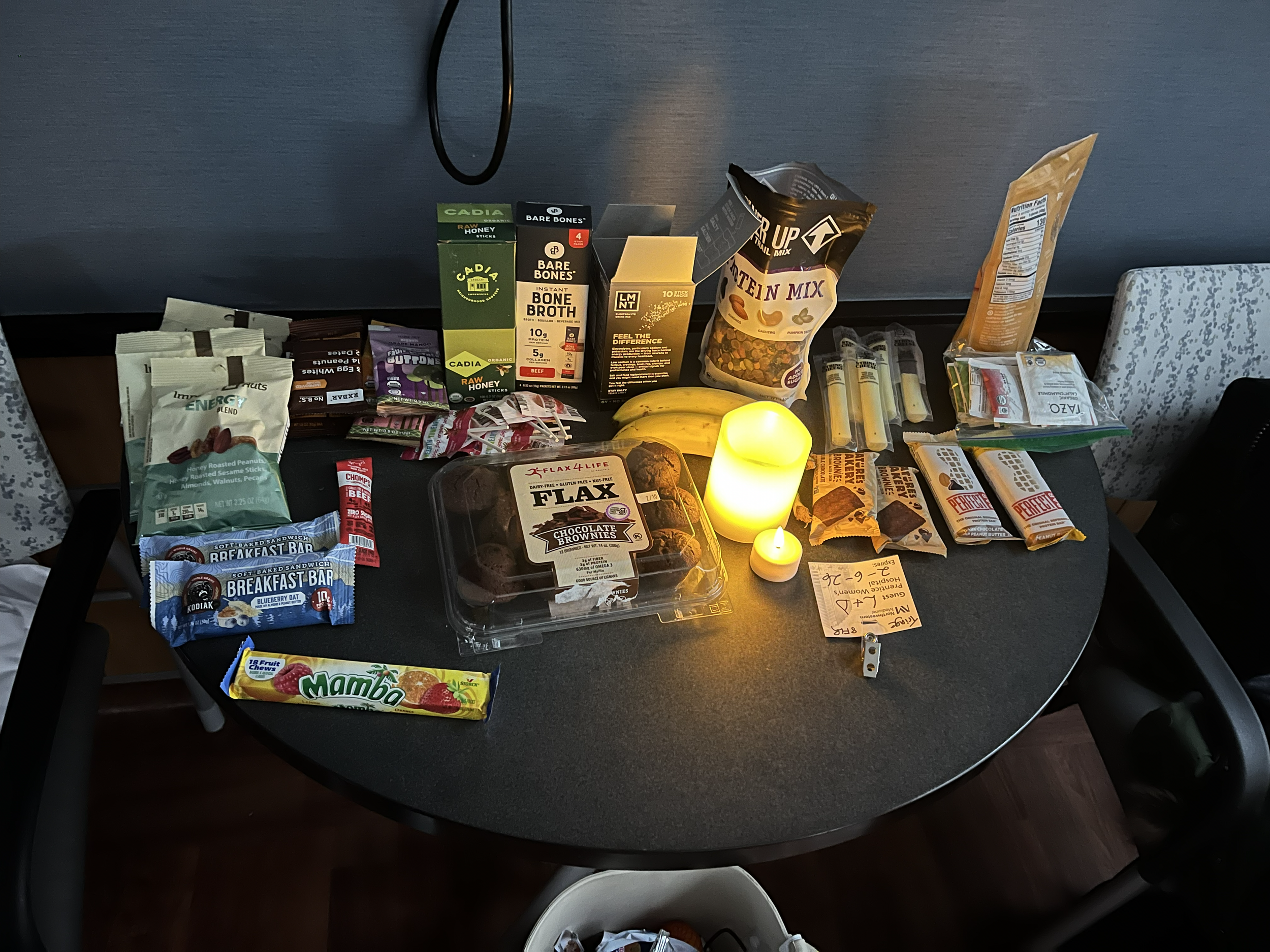
<— Check out this snack table! My client’s husband set this up at the start of their induction. Food was offerent to everyone who entered the room, and secretly my client snacked through her whole labor!
This is the second to last part of a blog series I’ve written to help laboring people reflect on their five senses in labor: sound, smell, sight and touch can be found at their links, and check out my introduction to the series here! In it I explain why I chose to write a blog about each of these five senses. My last part, on taste as it relates to fluids, is coming soon!
Taste is definitely the most controversial of the five senses in labor. That’s because almost every hospital has a policy to restrict food intake for laboring patients. This policy has a long history, but the most recent recommendation from ACOG (the American College of Obstetrics and Gynecology) is what most hospitals are basing their policy on. In their clinical guidance, they write “Current guidance supports oral intake of moderate amounts of clear liquids by women in labor who do not have complications. However, particulate-containing fluids and solid food should be avoided.”
I want to note here that in the same paragraph, ACOG goes on to say, “These restrictions have recently been questioned, citing the low incidence of aspiration with current obstetric anesthesia techniques. This information may inform ongoing review of recommendations regarding oral intake during labor.”
So while they’ve decided to restrict laboring people from eating, they acknowledge that this needs to be questioned and reconsidered. The problem? While they dither about whether or not people can eat, laboring people continue to be denied the ability to make informed decisions for themselves about whether or not they would like to eat in labor.
Dr. Rebecca Dekker, in her website Evidence Based Birth, writes it best:
“The issue of eating and drinking during labor should be reframed as one of bodily autonomy and human rights. All laboring people, whether they have an epidural or not, or have diabetes or not, have the right to choose whether they would like to eat and drink during labor. Here at Evidence Based Birth®, we urge the American Society of Anesthesiologists and the American College of Obstetricians and Gynecologists to revisit their current guidelines and adjust them according to the evidence and ethics. Any revisions in guidelines should also consider parental satisfaction. There is abundant research showing that people often complain about their distress in being forced to fast during labor (Manizheh & Leila, 2009).”
OK, mic drop! I wholeheartedly concur here. I can’t tell you how distressing it is to watch a laboring person, who hasn’t eaten in 24 hours, look at me while pushing and say, “I’m too tired to push, I’m so hungry.” and then not be able to give them a bite of food because a nurse is watching to make sure we are following hospital policy.
This does change a bit from hospital to hospital. Some places I’ve been to will allow you to eat anything before you get an epidural, or before they start using pitocin. Some places have nurses that allow you to eat because they know you need it, while others are rule followers. I always recommend asking your provider about eating and drinking in labor! With that information you’ll be able to make an informed decision on if you want to eat or not.
Now, all of this is about once you enter the hospital. But let’s say you go into spontaneous labor and spend a lot of time at home! There are no restrictions at home. You get to eat what you want, when you want, and I’m a big advocate of this! Especially in early labor, as things are still getting started, I always recommend to clients that they eat something filling and delicious, as this might be the last big meal they get before they meet their baby! There are no real restrictions on what this could be, but I always remind people that nausea and throwing up are common side effects of labor, so whatever you eat, think about how it might feel coming back up. A recent client of mine had birria tacos before labor began, and while she loved them and they brought her joy (and therefore necessary oxytocin), she really regretted it later on in labor!
Generally, I recommend:
Soups
High carb meals like pasta, cereal, bread, rice, etc.
Fruits
High protein snacks (beef sticks, granola bars, and string cheese are some highly rated foods from clients of mine!)
There’s really no wrong answer here! One client of mine used her last big meal before birth as part of her ritual: she saved a new ramen restaurant in her area for the moment she went into labor. As soon as she started with contractions, her partner ordered take out and she got her wish! She credits this meal with helping her mind feel ready for the journey of childbirth.
Once active labor begins, you’re not going to want to eat something big anymore. At this point, think about things that you’d like a single bite of:
Granola bars
String cheese
Crackers
Honey sticks (yes, these are considered a food and not a clear liquid in some hospitals)
Fruit bars
Broths and soups
Throughout labor, I recommend small bites, to keep your energy up throughout the process of childbirth. High sugar, high calorie foods are good because they’ll help provide you with quick energy that you’ll burn quickly. Pro-midwife tip from my favorite midwife Carly Ann Braun-Marshall - what’s your favorite candy? Bring it! That’s a quick hit of sugar that will also bring you a little joy!
As you reflect on what you want to eat, here are some questions to consider:
Are you someone who gets hangry? How will hunger impact your feeling of safety, respect, comfort and love during your labor?
What are your comfort foods? Will they translate to labor?
How do you feel about the hospitals “clear liquids only” policy? Are you someone who wants to follow that (and if so, how will you prep ahead of time to get the nutrients you need?) Or are you someone who might break the rules if you feel like eating?
And the time-honored tradition question: What’s the first thing you’ll eat once your baby is born?
One final thing: sometimes you just don’t want to eat in labor. And that’s OK too! True body autonomy means you get to decide for yourself if you eat or not, what you eat, and when. I hope this blog has helped you think a bit more deeply about eating in labor. Want help planning snacks? Want help in labor? Want to tell me your favorite food? Hit me up here!
Citations:
American College of Obstetrics and Gynecology
Restriction of oral intake during labor: whither are we bound?
Evidence on: Eating and Drinking during Labor - Evidence Based Birth