The Bathroom - Why I Love this Laboring Spot!
Average Read Time: 3-5 minutes
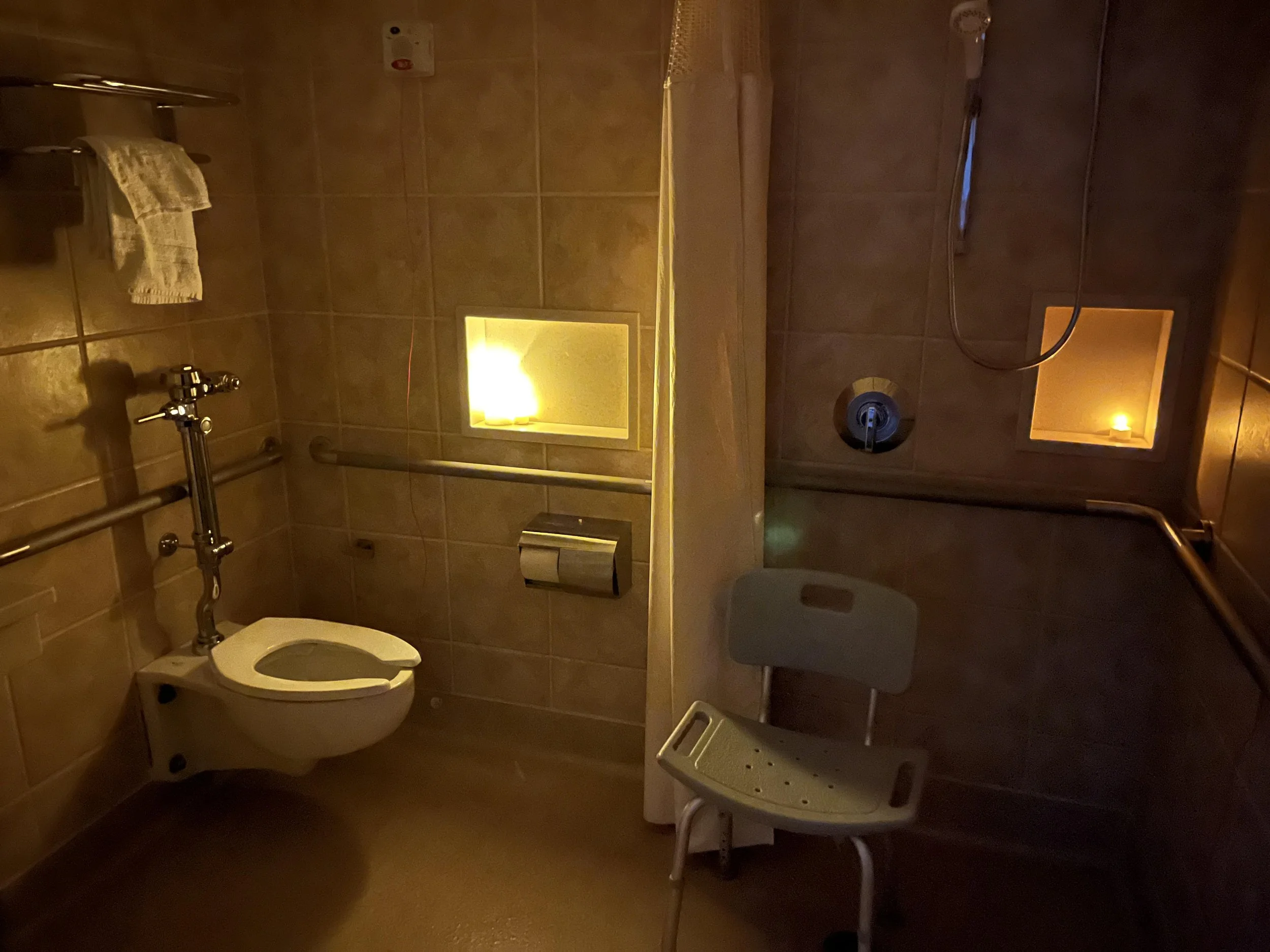
I always get a combo of laughter and skepticism when I bring up the bathroom in my childbirth education class. Why am I making a bunch of adults crowd into a small bathroom? Why am I sitting on a toilet, fully clothed? I swear, there is a purpose to my preposterousness.
<— This is the bathroom at Prentice. The partner of my client set up a “spa” for his wife, who spent a lot of time laboring right here!
Release - Think about the bathroom for a second. What does your body do in that space? It releases! In the very area someone needs to release when they are in labor! Sitting on the toilet generally activates your muscle memory to let go. In labor, your body needs to open, to release, to let go. Why not use what your body already knows how to do to your advantage?
On that note, another thing that the bathroom helps you release is your bladder! As a doula, I am always watching to make sure my client is peeing as much as possible - roughly every thirty minutes is an ideal cadence. This tells me that my client is well hydrated. Thirst tenses up the body, creating more pain and negative sensations to navigate through labor. Peeing also helps shrink the bladder, giving more space for the uterus, and for your baby to make their way down.
Privacy - Another thing about the bathroom is that it’s generally private. We go in alone and people know to leave you alone. It is a private space, and societal norms are pretty clear - if someone is in the bathroom, leave them be!
During labor, the norm is mostly still upheld. Nurses, the people who are usually the first to come in and check on you, won’t just barge in on someone in the bathroom (hopefully! And unless it’s a medical emergency!). When a nurse comes in and my client is in the bathroom, the most typical response I hear is, “oh, wonderful! I’ll come back when they are out.” Privacy - the bathroom gives people a moment alone. I especially recommend this when laboring people feel overwhelmed. When the nervous system needs less stimulation, I guide people into the bathroom to get a little more space. I usually offer for the partner to join, that way the laboring person still has support, but it’s only from their beloved, the person in that room who knows and trusts them the most.
Cave - Environment matters so much during labor. Each person has a unique set of needs to create an environment that makes them feel safe, loved and respected. A trend I notice for many laboring people is that lights really matter. For this reason, I carry LED candles in my doula bag, and encourage my clients to bring string lights, salt candles, or other (non-flamable) lighting to help set the mood. In the bathroom, I add candles to create a cave-like experience (see the picture above!). The lights are able to stay off, and people can labor in an environment that helps keep their nervous system as calm as possible.
Shower/bath - The bathroom also has some of my favorite pain management tools in it - the shower and the bath! The American College of Nurse-Midwives compiled a PDF of the primary research around hydrotherapy, and concluded that benefits include:
Decreased perception of pain during labor (also see this research article, which concluded that hydrotherapy lead to a decreased pain experience with laboring people rating their pain at a 6 rather than an 8)
Less severe perineal trauma and tearing (and lower episiotomy rate, as explained in this Evidence Based Birth article)
Lower risk of hemorrhage
Decreased need for medical pain relief, such as epidural use
Greater satisfaction with birth (also see the NIH research article above, as well as the Evidence Based Birth article above)
The shower and the bath also have great potential to be worked into a ritual. Ritual is one of the three Rs that can help laboring people cope with the intense sensation of contractions. The shower can be incorporated into a ritual in many ways - some examples would be to use a moveable showerhead over a specific area of the body during a contraction, having the showerhead give gentle massage over the back, belly, or other part of the body, etc. The bath can have a similar effect. One ritual I’ve seen used a lot is for a support partner to take a cup and gently pour water over the back or belly of a laboring person, during or in between contractions. Many laboring people spontaneously create their own ritual in the shower/bath, so if you’re a support person, make sure to follow their lead!
Positioning - In the bathroom, you can also get creative with positioning. You can lean on the sink countertip (and take advantage of being able to splash water on your face in between contractions!). You can sit forwards OR backwards on the toilet, leaning into a pillow to make it more comfortable. You can use the toilet as a lunging stool - get your foot up onto the seat and lunge asymmetrically! There is no wrong way to labor in the bathroom, just follow your body and figure out what feels helpful! (I notice during many labors that people will go to their knees during or in between contractions. Support partners - put a pillow under their knees!).
Final Tip - Aromatherapy can be excellent in the bathroom! Especially when someone is struggling to pee, I’ll put peppermint essential oils in the toilet bowl, which can help with a natural release. You can also put other smells in the bowl to help create the environment you want; and the second that smell becomes gross, you can just flush the toilet!
I hope you find at least one tip in here that resonates with you as you create your labor plan. Use the bathroom - at home and at your birth setting! It’s absolutely a great place to help your mind and body labor and get ready for your baby.
Want help with your plan? Want more tips and tricks about laboring in the bathroom! Contact me here!