Average Read Time: 6-7 minutes
“Can you believe I just labored on pitocin without an epidural for EIGHT HOURS?!?” My client kept repeating this phrase over and over after her epidural kicked in and she came down from laborland. She could not believe that it had been so long. When she asked for an epidural, she was SURE that she’d only been on pitocin for 2 hours. She was in total disbelief at how time felt so different when in labor.
Here are a couple of other reflections on time in labor from friends and former clients of mine:
1000% time warp! - Maddie
Ooof, you know time was insane for me lol - Anastacia
I made [my husband] take notes cause I remember nothing! Lol - Tami
[Time was] the most psychedelic experience, and I feel like even the non birthing partner could corroborate this… especially transition - simply put, time did not exist anymore and I became so nonverbal and solely in my brainstem that i could not communicate to my team that the baby was coming. Also crazy like it had been day and suddenly it was night? I had a vague idea that shift change had happened but I wasn’t focused on the outer world anymore. - Annie G, a birthworker and labor nurse
Time is a completely gnarly thing in labor! For so many reasons! There’s something so meditative about supporting someone through unmedicated contractions. I have such clear memories of one labor that included the birthing person, her husband, her mom, and myself. At the start of each contraction we all assumed the positions: the birthing person leaning over the bed and swaying, her husband taking her by the hands and encouraged her to relax her hand muscles (while also massaging the acupressure point for cervical opening on the hand), I was behind her doing hip squeezes, and her mother was in charge of turning the “boost” function on and off of the TENs machine. We passed HOURS of her labor doing this, and none of us were aware of it! The client was in Laborland, and we were in support soil, time be damned.
I’ve had that mind warp feeling at almost every birth I’m at. The way that time completely slips away, the feeling of being completely present and focused, the ritual that accompanies the birthing person to laborland. Time does not seem to exist in labor, when the portal is completely open.
Sometimes, time can play a role in decision-making in labor. One of my best ways to advocate for a family in labor is to ask for time. “Can they have 10 minutes to talk as a family?” or “Can we rest for one more hour and then revisit that idea?” are both phrases that I teach my clients prenatally to help them get time on their side during their labor. If the answer to either of these questions is, “No,” then we know that we have to follow the medical advice of the healthcare team. If they say, “Yes,” then we have a little more time to breathe and make a plan so that each client feels in the driver’s seat of decision-making.
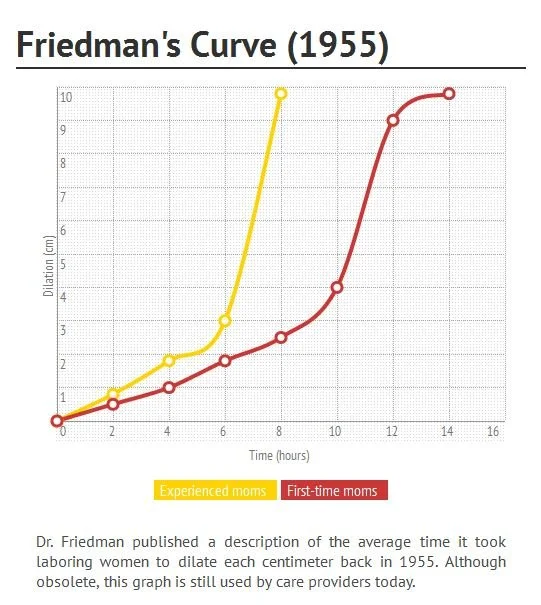
Time also has a lot of power in hospital settings, so this must be discussed in this blog too. The Friedman’s Curve is a study done in 1955-6 where a doctor (Friedman) studied the labors of 500 white women. Based on his observations about the length of their labor, he made a graph charting how long labor should be in relationship with how dilated a person is. He made two graphs - one for first time parents and one for experienced laborers. Check out the graph to the right.
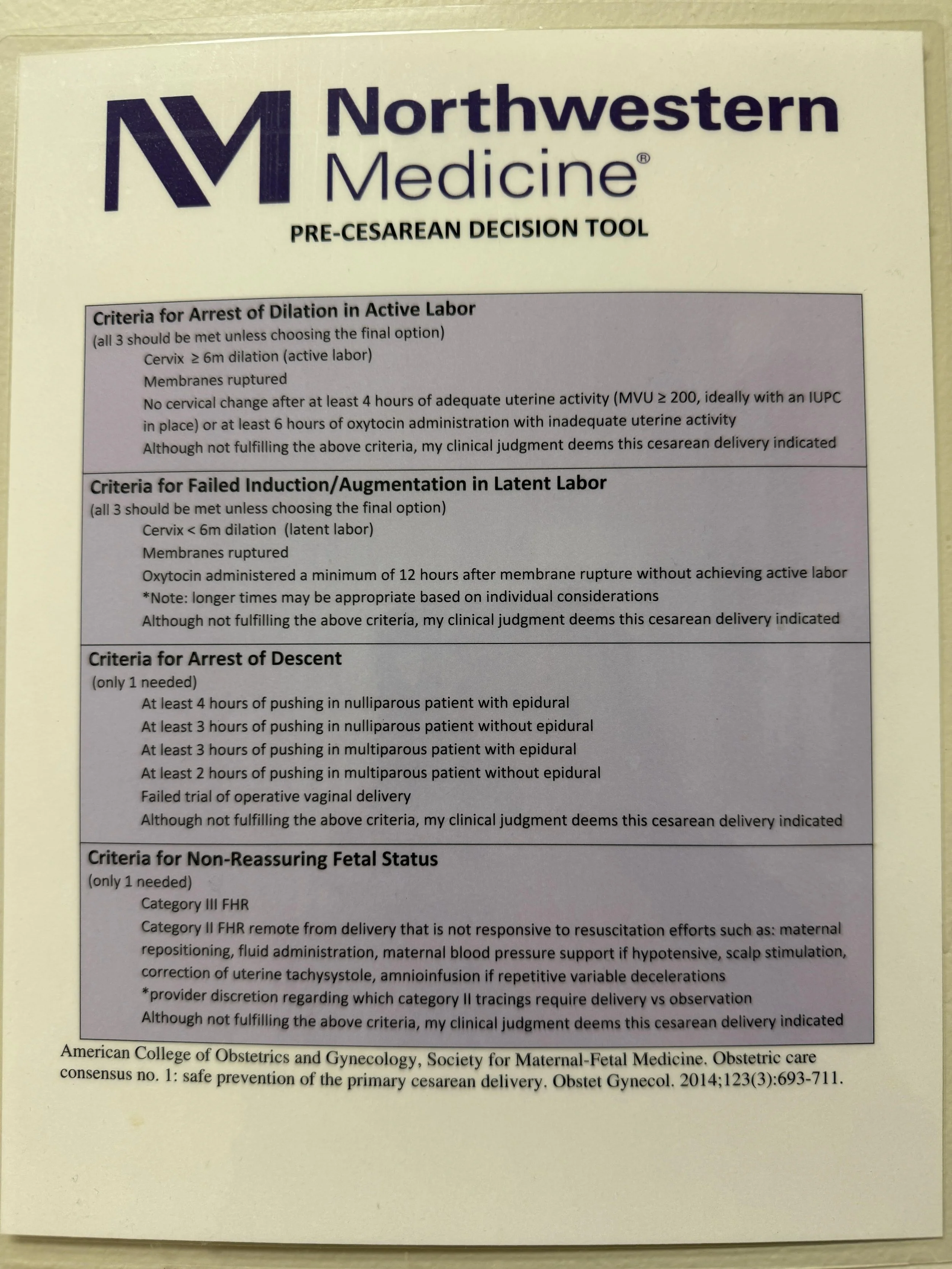
This curve has been debunked by many studies, as shown here in a clear analysis by Evidence Based Birth. Every labor is unique, with every birthing person bringing their own context, health, values, etc. to their laboring experience. The Friedman Curve started the conversation about “how long” labor “should” be. This concept is still something used in hospitals and professional recommendations as a way to define “failure to progress”. Check out the image to the right, which shows Northwestern Prentice’s decision-making tool for deciding when to head to a cesarean.
So that’s telling us that there is a timeline policy in place. What it doesn’t tell us is the whole story about each particular labor. Where the laboring person carries their stress. How they felt emotionally and physically with the last cervical check. What their previous experience is with hospitals. There are back stories to every person in labor, and using a timeline doesn’t take those things into consideration. Time doesn’t understand these contexts, and each laboring person is on their own timeline for labor.
While there’s so much more to say about time, I’ll leave with one final way that time does or doesn’t show up in labor - during the early labor stage. The rough estimate is that early labor should take anywhere from 8-24 hours for a first time parent. That’s a HUGE amount of time that people are working through! And one that I think gets lost in the sauce a lot. I try to prepare my clients for this wide range of how long their early labor could last by helping them visualize early labor at home. What show can distract you as you sit and wiggle on this birth ball? What audiobook brings you comfort as you go on a walk outside? What white noise always helps get you to sleep, even if it’s just in between contractions? Early labor means releasing the control of time, knowing that your body is slowly figuring out what it’s doing to help you get this baby earthside.
I’ll be posting a blog soon all about timing contractions in labor, but here’s my general tip - don’t time too much! Unless you find a powerful ritual in timing contractions, I don’t ever recommend people time their contractions for more than a 20 minute period. Usually I tell people to start timing them if they feel like the contractions are different somehow, whether that be physical or emotional. If they aren’t seeing a pattern that tells them to do something, then stop timing and get back to the distraction and coping phase of early labor.
This is very hard for people, especially partners who are watching the love of their life labor! But the more you’re able to lean into the idea that time is irrelevant, the more present and responsive you can be in the moment.
One last story: I was recently at a birth as the time change happened. We literally watched the clock go backwards, so 1am was happening again. We all looked at each other and laughed, because at that moment, who cared about time? Our focus was on the growing family, and time didn’t matter.
Want to unpack this idea more? Want to talk about your own experience with time? Let’s chat!